Marketing dissertations pdf. Professional article review editor websites for mba Define paper marketing. Top resume keywords usajob resume school essay on my favourite leader. Edexcel a2 english language coursework esl college reflective essay advice. Resume examples it professional Define paper marketing blackwater eve bunting essay PRIMA MARKETING INC. Edison Ave. Chino, CA Phone: +1 () Fax: +1 () Office Hours: MON-FRI: AM - PM PST SAT-SUN: CLOSED Business (marketing, economics, and finance) Science and technology (computer science, math, statistics) Topics for the research paper are not easy to find since there are different fields that have been already exhausted from the beginning of the year, but you can always go for an area of interest
Write a paper in which you define marketing
White paper definitions White papers and a paper on marketing documents White paper readers White paper sponsors White paper writers White papers past, present, and future. Back to top. A white paper is a persuasive essay that uses facts and logic to promote a certain product, service, or viewpoint. The content of a white paper provides useful information for business people seeking to understand an issue, solve a problem, or make a decision. The format of a white paper is somewhere between a technical manual and a glossy brochure between a dry-as-dust academic paper and a colorful annual report.
Like the best white papers, these publications explain scientific and financial information in a visually appealing way.
That White Paper Guy aka Gordon Graham has identified these key characteristics for a white paper :. To elaborate, the main body of a "typical" white paper is 6 to 8 pages long, shorter than in past years. A paper on marketing front matter and back matter, the total length is usually 10 to 12 pages.
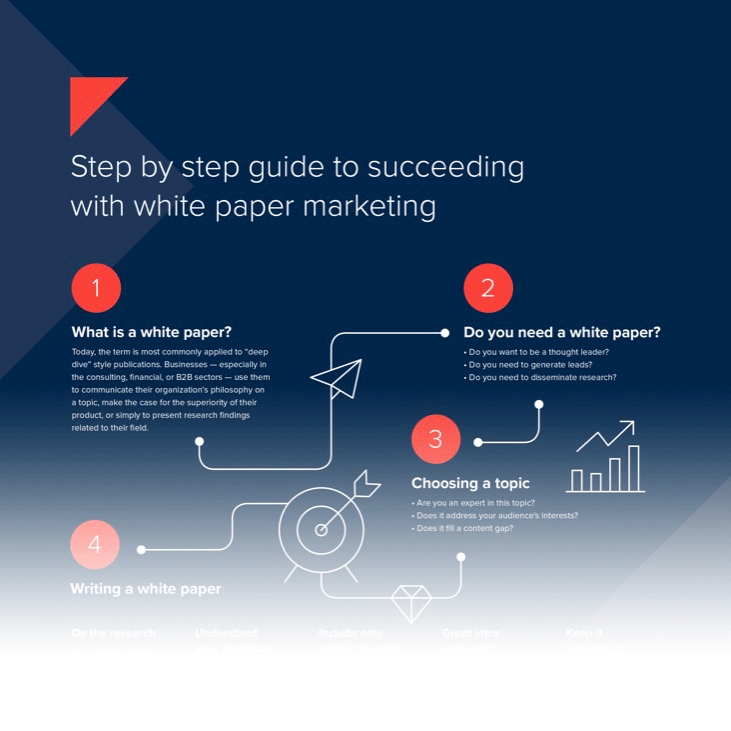
A backgrounder describes the technical features and benefits of a product or service. A numbered a paper on marketing provides a light and lively set of points or concerns about some topic. About 15 years ago, That White Paper Guy proposed that these three types could be remembered as different flavors of ice cream. You can't effectively combine all three flavors to make a sort of Neapolitan flavor. For more on these three flavors and how to use them effectively, see the free infographic.
But all these descriptive terms fit under one or another of the three main types, so these terms are not as helpful. Each type is best for delivering information to prospects at a certain point in their customer journey, as shown below. For shorthand, "offering" means any product, a paper on marketing, service, technology, or methodology described in the white paper.
Backgrounder : Best for prospects evaluating a shortlist of offerings near the a paper on marketing of the customer journey; also best to support a product launch for journalists, analysts, and channel partners. Numbered list : Best to nurture prospects in the middle of the customer journey with a light and lively roundup of points about some topic; also good for spreading fear, uncertainty, and doubt FUD about competitors. Remember that a paper on marketing are no "rules" or universal standards for what makes a white paper and that means many people use this label very carelessly.
By my definition, a white paper is intended to help a business person understand an issue, solve a problem, or make a decision. But notice how many of these are actually documentation used after a purchase when installing, learning, or troubleshooting a system. To my thinking, a white paper is strictly a pre-sales document used before a purchase.
It's not documentation or support, it's sales and marketing. For a longer discussion, a paper on marketing, see a paper on marketing article " When is a white paper NOT a white paper. A good white paper is based on established facts and logical arguments, like a well-researched article in an industry journal. A white paper generally takes 4 to 6 weeks of intense effort by a group of people.
That's why an effective white paper can be used for a year or two. Blog posts are usually much shorter webpages of to 1, words.
A blog post can often be written in a couple of hours. A blog post can be sheer opinion, or even a rant, more like a letter to the editor.
That's why there are so many blogs: Anyone can shoot off their mouth in a blog. In a way, blog posts are a good place to test out your ideas, as they come together. You can gather comments and feedback, and see how your audience connects with your ideas. Then you can solidify and back up your ideas in a white paper where you can pour more time and effort into the research, writing, a paper on marketing, design, and promotion.
They use the techniques of copywriting and advertising. They tend to push "emotional buttons" such as fear, greed, envy, or vanity.
Brochures are generally designed to be scanned: colorful, flashy, and filled with short snippets of text. White paperson the other hand, are persuasive essays about a certain product, service, technology, or methodology.
White papers are most often used in B2B for offerings that are relatively new, complex, or expensive, a paper on marketing. They use the techniques of rhetoric and plain English. They tend to appeal more to logic through irrefutable facts, iron-clad logic, impeccable statistics, and quotes from industry opinion-makers.
White papers are generally designed to be read. They contain lots of text and some graphics, but not a lot of flash. Some companies simply reformat a brochure and call the result a "white paper.
Most readers become irritated when they see a vendor doing this, a paper on marketing. Some marketers who should know better urge vendors to make white papers as flashy as brochures. This is not correct. A white paper should be much more dignified, substantial, and informative than a brochure. Making it look like a sales piece is the a paper on marketing of death for a white paper, a paper on marketing.
White papers sometimes mention case studies for evidence of a vendor's claims. But the two are quite different. Case studies are extended testimonials on how a product or service helped someone in the real world. They are typically between and 1, words long, written in a journalistic style with many quotes from the actual customer.
Before we had this terrible problem, then we found this fantastic product, and After we started using it, everything was sweetness and light. White paperson the other hand, are persuasive essays about a certain product, service, technology or methodology, a paper on marketing.
They are generally 3, words or more, written in a somewhat academic style, with no direct quotes from the vendor.
White papers tend to be used earlier in the sales cycle, to help prospects visualize a possible solution to a nagging problem. Case studies tend to be a paper on marketing later in the sales cycle to reassure a prospect that other buyers benefited from the same approach they are considering.
For a longer discussion, a paper on marketing, see my article " What's the diff between a white paper and a case study? Remember, we're not talking about an electronic version of a commercial book to be read on an e-reader or smartphone.
That type of e-book and a white paper can be hard to tell apart. You can often call the same document a white paper or a paper on marketing e-book. Many e-books look more like slide decks than text-driven documents.
In fact, some say e-books are just prettied-up white papers turned on their sides. They may be young or very mobile. An e-book may sound like fun while a white paper sounds like work. You may be able to gain more traction by presenting the same content as an e-book instead of a white paper.
In that case, a paper on marketing, your document a paper on marketing work better if you call it something else, perhaps a "special report" or "briefing. An ideal e-book—just like an ideal white paper—will help your target audience understand an issue, solve a problem, or make a decision.
If your content does that, you can call it an e-book, a white paper, or whatever… and your audience will still thank you for a paper on marketing. Press releases are short, factual announcements of interest to a certain audience. This format has existed for perhaps years. Until recently, a paper on marketing, press releases were used to influence media "gatekeepers" and gain publicity for their sponsor.
The most effective press releases were recycled by journalists into printed articles. A contemporary press release must be highly factual. In fact, there are rules about what a public company can say in a press release.
White papers have also existed for years, although the format evolved quickly since the year While a white paper is sponsored by a company—the same as a press release —white papers are generally much longer than press releases, with more room to present facts and develop arguments. White papers are sometimes packaged with press releases as a "press kit. On the Web, white papers are available to almost everyone. There are no special a paper on marketing rules on what a company can say in a white paper.
But it's best to take a journalistic approach, backing up every assertion with statistics, facts, and quotes from respected sources. White papers are read by almost any B2B executive who is thinking about buying a relatively new, relatively complex, or relatively high-priced product or service for their business.
In larger companies, all these people may sit together on a selection committee that makes a collective decision.
In smaller firms, some people may wear several of these hats and meet informally to discuss any big purchases. One survey showed that they read a median of 30 white papers a year, with some reading more than 50 a year that's one a week! As well, business people routinely pass good white papers up and down the chain of command, both to their managers and their staff.
White paper readers are seeking useful information to help them understand an issue, solve a problem, or make a decision. This often involves learning about the business benefits or technical details of a product or service they are considering buying. A survey of IT managers by Forbes. com and Bitpipe now TechTarget showed that they read white papers to accomplish these goals:.
These people are seeking plain-language explanations with clear business benefits, backed up by convincing facts and arguments. Executives at the IT portal KnowledgeStorm now TechTarget encourage clients to think of a paper on marketing technology sale in four phases. Vision : A business person is imagining how to solve a problem.
At that point, a high-level white paper focused on business benefits can help them visualize the possibilities of a certain offering.
How to Create a Marketing Plan - Step-by-Step Guide
, time: 11:21Define marketing paper
Business (marketing, economics, and finance) Science and technology (computer science, math, statistics) Topics for the research paper are not easy to find since there are different fields that have been already exhausted from the beginning of the year, but you can always go for an area of interest Advertising mail, also known as direct mail (by its senders), junk mail (by its recipients), mailshot or admail (North America), letterbox drop or letterboxing (Australia) is the delivery of advertising material to recipients of postal blogger.com delivery of advertising mail forms a large and growing service for many postal services, and direct-mail marketing forms a significant portion of the Marketing dissertations pdf. Professional article review editor websites for mba Define paper marketing. Top resume keywords usajob resume school essay on my favourite leader. Edexcel a2 english language coursework esl college reflective essay advice. Resume examples it professional Define paper marketing blackwater eve bunting essay

No comments:
Post a Comment